

Prediction markets are everywhere now. You can use prediction markets to bet on nearly anything. Recently, it was reported that a firm (or simply some other third party) had used prediction markets to bet on particular outcomes for college football teams, with payouts that coincidentally equaled what the school would owe its coach if the team achieved that outcome. What in the world is going on here?
Compensation and Performance
Suppose you are an employer and thinking about how to compensate your workers. If you pay them a fixed salary, you have a good idea of what your costs are going to be. However, there is uncertainty about revenue. If you pay your workers a fixed salary and the company has a very good year, all the extra revenue is a windfall. However, if you have a bad year, you might have to let those workers go, or you might have to completely shut down your business.
Alternatively, you could write a different employment contract. You could make your workers’ salaries a function of revenue. When times are good, workers get more compensation. When times are bad, workers get less compensation. This eliminates the windfalls you will get during good times, but it reduces your costs during bad times.
The pay structure also affects the workers’ incentives. Imagine you own a roofing company. You could pay your workers hourly or you could pay them by the job. If you pay them by the job, they will have an incentive to finish each job quickly so they can move on to the next one. More jobs mean more revenue for you and more compensation for your employees. However, by paying them by the job, you are incentivizing speed. In doing so, you might also incentivize carelessness, which might lead to roofing shingles blowing off the roof during a storm. This creates unhappy customers and reduces the present discounted value of future demand.
By contrast, paying the workers by the hour disincentivizes speed. Workers will not necessarily be in a rush to complete a job because they get paid the same amount for a given number of hours, independent of how many jobs they complete. That could result in higher-quality work. The workers are more likely to take their time and do the job correctly since they don’t have a financial incentive to get to the next job. However, fixed hourly pay might lead them to shirk.
Which option you choose is likely to be determined by my ability to monitor the workers. Armen Alchian and Harold Demsetz presented a theory of the firm based on monitoring and information costs. According to their theory, when workers are engaged in team production but their individual productivity is difficult to monitor, you are likely to get shirking. The solution to this problem is to hire a manager who can monitor the workers and whose compensation is tied to the success of the firm.
However, it is important to ask what the manager can monitor and how costly it is to do the monitoring. My roofing example illustrates a point made by Yoram Barzel that wage contracts require monitoring effort whereas per-job contracts require monitoring the quality of output. The option you choose will depend on the relative costs of each type of monitoring.
Many contracts are not either/or compensation schemes. Many contracts are fixed compensation plus incentives. This works when the output in question is easy to identify. For example, suppose that you want to hire someone to build a new factory. It is important that the factory be built by a particular time. You might offer to pay the builder a fixed dollar amount for construction with a bonus if it is finished by a particular date.
We also see this in sports. Professional athletes are often compensated for achieving easily measured outputs. The same is true of coaches, who are often given a base salary with additional earning opportunities tied to performance.
It is obvious why this would apply to sports. Inputs are hard to measure. Think about coaching. Every coach has their own philosophy on how the team should practice. Some coaches like to coach hard. Other coaches like to practice light to keep their players healthy. Some coaches like to yell at their players. Others prefer positive reinforcement and prefer not to yell. If I hire a coach and I try to monitor the coach’s performance based on the inputs, like observing how many hours he spends in his office or at practice and how he runs practices, it is probably going to be difficult to do. Successful coaches don’t have one observable style. What works for one coach might not work for another.
Outputs, however, are easy to measure. The coach’s team is either going to win or lose. I can easily observe which outcome occurs. Thus, it is much better to use incentive-based compensation for the output than the coach’s input.
Financial Markets
Now let’s return to how I began the previous section and discuss uncertainty. There are various sources of uncertainty in production. Let’s think about a specific example. Imagine that you are a farmer. Some amount of your production is determined by your inputs, the amount of seed you plant, the type of seed you plant, the amount of irrigation you provide, etc. However, some things are beyond your control. Bad weather can lead to a bad harvest in terms of a reduction in yields, lower quality crops, or even the loss of particular types of crops. The same can be said for infestations by insects or pests that trample, eat, or destroy some of the crops. You also face uncertainty about the price of the crops that you are selling. You plant your crops with some expectation of what the price will be. However, a lot of things can happen between when you plant and when you take the crops to market.
Let’s focus specifically on this price uncertainty. Farming is a time-to-build production process, by definition. You have to expend the resources to plant, fertilize, and irrigate. The output comes later, when the crops grow. Fluctuations in prices therefore create a risk. What you are willing to invest ahead of time depends on what you expect prices to be when you bring your harvest to market. If you come to market when prices are higher than you expected, you get a windfall. If you come to market when prices are lower than expected, you might not have enough to cover the wages that you have paid. The equity you have in your farm is the amount of assets less liabilities. Should you not have the revenue to cover the costs, your equity will decline as you cover those costs. If the revenue is sufficiently low, you might not have enough equity to cover the costs and will become insolvent.
The really bad outcome here is the downside risk. If your goal is income and survival, then you might be willing to forgo the chance at a windfall for greater certainty about the price.
This is where financial markets come into play. Suppose that you are worried about the price of your crops. What if you could sign a contract today to sell those crops at a fixed price in the future? That would solve your uncertainty problems. But who would accept that risk?
It turns out that there are people who might be willing to bear the risk. For example, someone who uses your crops as an input in production. Whereas high prices produce a windfall for you, they increase the costs of production for others and make it harder for them to compete. They want to eliminate upside risk in the price. You want to eliminate downside risk. Thus, you sign a contract with a fixed price ahead of time and neither of you has to worry what happens to the price in the interim.
Another person who might be willing to agree to this contract is a speculator. Suppose that this contract is tradable. The speculator might buy the contract in the hopes of selling it for a profit at a future date if the price rises. The cost to the speculator is that there is a chance that when the contract expires, the price has fallen. The speculator will then need to sell the contract to someone willing to take delivery of your crop and doing so will result in a financial loss for the speculator.
This type of trading occurs in futures markets. However, with prediction markets, there are all sorts of opportunities to do something similar.
Prediction Markets, Universities, and Hedging
All of that brings me back to the subject of the introductory paragraph. Some trades have been made on prediction markets with payouts equal to bonuses built into college football coaches’ contracts. To be clear, the schools themselves did not make these trades.
College football coaches tend to have fairly standard contracts. There is a base salary and then there are incentives built into the contract. Making the playoffs and advancing to each of the next rounds of the playoffs and winning the championship tend to produce bonuses for coaches.
When we discuss these contracts, these clauses are often referred to as “contract incentives.” However, as I just discussed, there are a couple of reasons why you might include bonuses in a contract. The first is that you are paying for performance. The second reason is that you are sharing some of the risk associated with random things that could go wrong. The revenue generated by the school will be tied to the success that the team has on the field. Players get hurt. Games are played in bad weather, which mitigates raw athletic differences. Star players have bad games. Mediocre opponents play the greatest game of their lives. Bad luck might limit ticket sales or playoff appearances, which reduce revenue. Including bonuses tied to performance means the school and the coach share that risk.
What is remarkable about the recent story is that it seems that schools like LSU and South Carolina (those included in the story) seem to be betting on their own successful performance using prediction markets. By doing so, they are able to insure themselves against their own success, which would result in significant bonuses for their coaches.
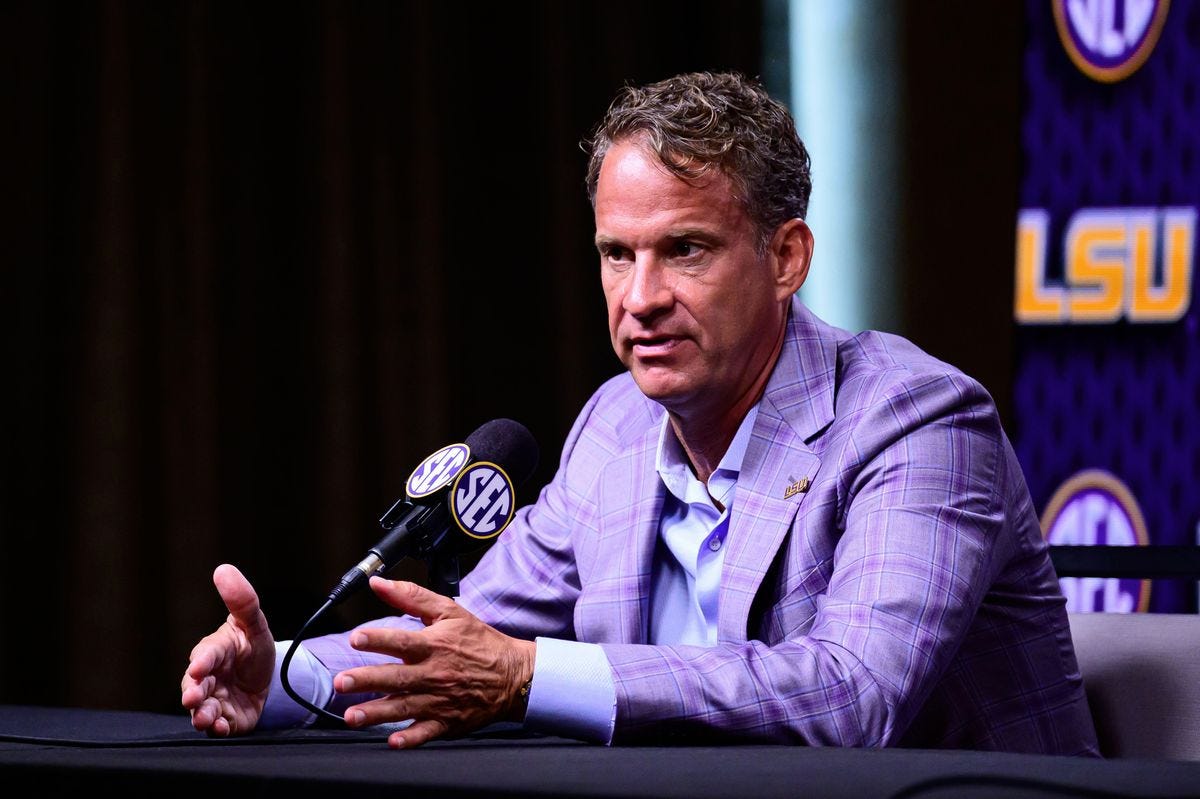
Although the schools are not directly involved in these trades, there are insurers that have underwritten policies to cover bonus payouts in the past. It is possible that the trades are a coincidence. However, it would be quite the coincidence for the payouts from five trades to almost exactly equal to the bonus amounts in Lane Kiffin’s contract at LSU. What seems more likely is that insurers or other third parties representing the schools are using prediction markets to manage their budgets and protect themselves against large bonus payments in the event of on-field success.
Why use insurers or third parties to interact with prediction markets? This seems like regulatory arbitrage. College athletics has strict rules about gambling on sports. One recent scandal involved quarterback Brandon Sorsby, who was deemed ineligible to play when it was revealed that he had placed thousands of sports bets using online betting apps. Players and staff are prohibited from gambling. Although prediction markets are not operated by sportsbooks, NCAA rules do not seem to care about the distinction. One way to get around this would be to pay an insurance premium to an established insurer. In exchange, the insurer takes some of that premium and uses it to purchase event contracts with prediction markets and keeps what is left of the premium as its profit for serving as middleman.
There is reason to believe that this might happen more frequently in the future. College sports are now permitted to share revenue with their student-athletes. Some sports have significant costs but very little revenue. Salaries for coaches remain quite high. To compete, schools are facing tighter financial constraints. As a result, schools might be willing to effectively pay a higher base salary by using prediction markets to price the risk of their success. As prediction markets become more liquid, they might price risk more accurately. Insurers and other third parties might find it profitable to serve as a middleman between the schools and the prediction markets.