

Before I get into this week’s newsletter, I just wanted to encourage everyone to subscribe/follow/whatever the term on TikTok. The newsletter is still alive and well but we are trying to teach economics wherever we can.
If you’re more my generation or older, I’m also posting to Instagram and YouTube.
The first two videos were on price controls (always) and tariffs (also always). Enjoy and thanks for the support!
Monopsony is usually told as a story about market power.
The textbook monopsonist is the sole employer in town. They’re the only job in town, so they are only competing with people who are desperate for work or those who can stay at home. Hiring more workers means raising the wages to attract more workers, and, by assumption, you have to pay all workers that new high wage. The monopsonist doesn’t like this, so “under hires.” A firm that’s a small buyer in the labor market doesn’t have this problem. It pays a going fixed wage. That’s sort of the setup we’re used to thinking about.
Instead of monopsony and all the baggage of “mono”/one buyer, economists often define buyer market power as the existence of a markdown. It’s the gap between the last worker’s worth to the employer and the wage. A competitive employer would have no gap, so any gap looks like something like market power.
Yet I’ve argued that we should think of these gaps as residuals, and different models leave them unexplained. There are lots of reasons for markups/markdowns, completely unrelated to market power. I’ve stressed that it is a return to some fixed cost.
Let’s consider a slightly different situation. Let’s assume the employer simply has to pay the same wage to all workers, either because of a union negotiation, social norms around it, or it’s just simpler from an implementation/HR perspective. Doesn’t matter. We also need it to bind every firm in the industry. That’s trivial in the monopsony example since there is only one firm, but it is important to be clear here. That’s going to do a lot of the work. We also need that they hire many different workers at that same wage. I’ll call that a uniform wage regime.
To be a bit more vivid, imagine a contractor who hires a laborer, a carpenter, and a plumber. Each has a going rate for their trade that the contractor can’t influence, but because of this uniform wage, everyone on the crew gets the same wage. Now, to add the plumber to the crew, the contractor has to pay the plumber’s wage to the laborer and the carpenter. Hiring one more worker means raising everyone’s pay. It should be clear that we have the exact same problem as the textbook monopsonist, except that we’ve assumed the firm has no market power and can’t move any trade’s market wage.
What’s the deal?
James Buchanan and Robert Tollison pointed this out in a 1981 paper (HT: Vincent Geloso). In both cases, the firm stops hiring while the last worker is still worth more than the wage, so you’re left with a markdown that looks like market power and an inefficiency. So what exactly does a markdown tell us about market power, if we can generate the exact same hiring decision without any?
However, the two stories differ in what closes the gap.
In the textbook, if entry is possible, monopsonists would face more competition among employers, which would reduce the markdown from market power. The markdown from a uniform wage survives free entry. Every contractor already takes each trade’s wage as given, and each one still has to raise everyone’s pay to add the plumber. Letting different jobs pay different wages removes it.
In this week’s newsletter, I want to walk through their argument, what it means for the basics of price theory, and then go one step further by correcting a mistake in their paper.
Hiring different roles for different pay
Buchanan and Tollison’s starting point is that jobs can be equally valuable to the firm internally but differently costly to fill externally. Equal value is a simplifying assumption. Each role adds as much to the crew as any other, though the trades still do different jobs. A real contractor may value a plumber more than a laborer, but assume it doesn’t, so that the only difference between them is what each could earn elsewhere. That outside wage is the worker’s opportunity cost, and anything paid above it is rent. For pricing, they argue, two workers are different inputs whenever their opportunity costs differ. So we have a clean separation between what a worker is worth inside the firm and the worker’s opportunity cost, what the worker could earn in the next-best job.
Let’s put aside uniform wages for a second.
The key restriction is that each role on the crew is a different job. You can’t build a house with five laborers. So adding a role means adding a different trade, and the contractor adds the cheapest trades first, hiring the people with the lowest opportunity costs, so each added role costs more than the last. The team’s supply schedule slopes up, but not because of buyer power. The firm changes no one’s wage. It just reaches into pricier trades.
If the firm pays each role the going market rate, that schedule is the firm’s marginal cost of labor, and each hire costs exactly its opportunity cost. The firm adds roles until the last one is worth its wage.
The outcome is efficient, because a role gets filled only if it’s worth more inside the firm than outside. That’s normal competition. There’s no discrimination, nothing nefarious, and no market power. Nobody thinks a contractor discriminates by paying a plumber more than a laborer.
Equal Pay
Now, let’s add this uniform pay schedule. Under a uniform pay scale, everyone is paid the wage of the last role filled. So the supply schedule stops being the marginal cost of labor and becomes the average cost of a worker. The cost of a hire is now
Cost of a hire = the hire’s wage + the raise for everyone already on the team
So now we have a clean divide:
The opportunity cost
The rent (surplus) that will be paid
It’s the same split between what a buyer pays and the real resource cost. I prefer surplus, but they use rent.
Now imagine that every firm in an industry follows this equal pay. Each firm’s cost per unit of output rises because it’s now paying rents to everyone below the top of its scale. Profits were zero before the rule, so firms lose money until the price rises enough to cover the higher cost. Relative to a world without equal pay, output falls, and we have an allocation problem where buyers lose output that’s worth more to them than it costs to make.
We also end up with winners and losers from this equal pay. Workers at the bottom of the scale who keep their jobs collect rents since they’re paid the top wage. Workers at the top lose little if they’re dropped; they take their market wage elsewhere, and consumers pay for the rents, mostly through higher prices. That’s why Buchanan and Tollison expect the push for one wage to come from low-wage workers who expect to keep their jobs.
We still have the same type of inefficiency, but the returns aren’t going to the firm.
Does a minimum wage work the same?
In many ways, this looks just like monopsony. With a monopsonist, a minimum wage can raise employment. Does a minimum wage in this industry raise employment too? Buchanan and Tollison say no, but they are wrong.
This is going to be a bit more subtle. Let’s try it without math.
Now let’s push the uniform wage slightly up from what firms would choose. A sufficiently high minimum wage will always cause problems. We are considering a marginal change here. We’re imagining a union contract with more aggressive bargaining, or maybe an industry-wide minimum wage. Again, we’re holding fixed what each tradesperson could earn elsewhere.
We need to disentangle what the higher wage means for the costs to each firm, how it changes decisions for the firm, and what it does to the industry once firms can enter and exit.
Buchanan and Tollison get the static inefficiency logic right. The uniform rule causes firms to stop hiring too soon, relative to the fully flexible, efficient benchmark. They grant that a higher required wage can make each surviving firm hire more because it lowers the marginal cost of a hire. That’s just like monopsony.
They claim this parallel doesn’t apply to the long run. In the long run, according to them, a higher wage gives workers more rent, and more rent raises costs. Since the industry was already at zero profits, higher costs are going to drive firms out. Firms will leave. Output will fall, and prices will rise. Less output needs fewer workers. Employment also falls.
There are a lot of connections, and we need to be careful. They slip up a bit. Costs do rise, and output does fall, but only a little. The missing steps are the next two. We can’t go from less output to fewer jobs or from more rent to more waste.
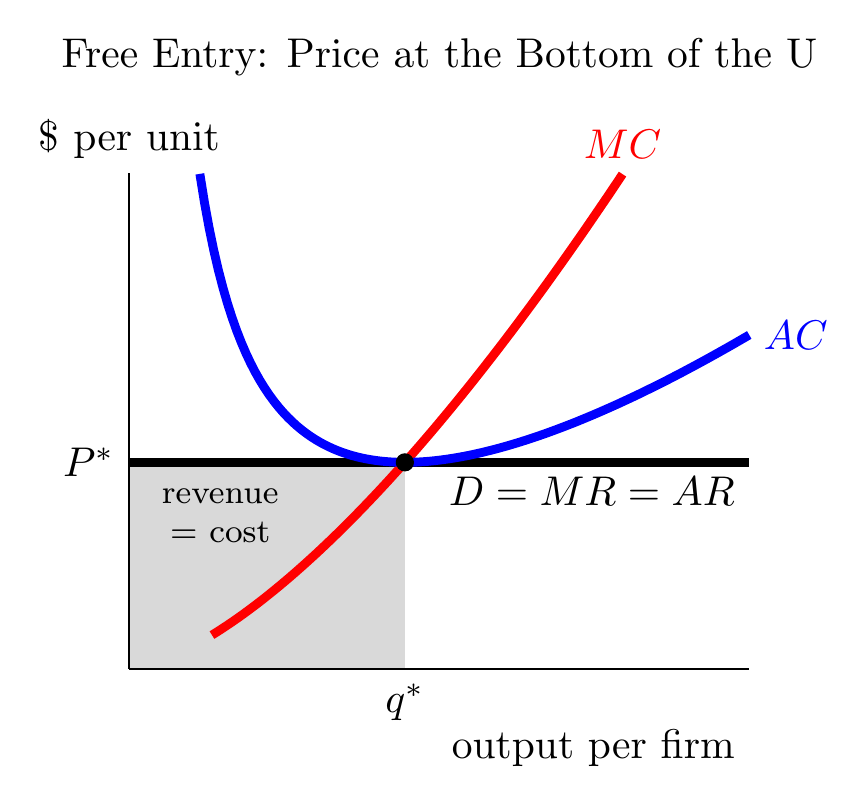
Cost per unit of output is U-shaped with respect to crew size. This is the standard textbook reason that bigger crews spread the fixed costs of running a firm over more output. Add that with an upward-sloping marginal cost curve, and eventually the cost savings per unit get swamped by the rising marginal costs, and so you get this U.
If firms are identical, free entry puts every firm at the bottom of the U, and the wage firms pick is the market wage of that crew’s last trade.
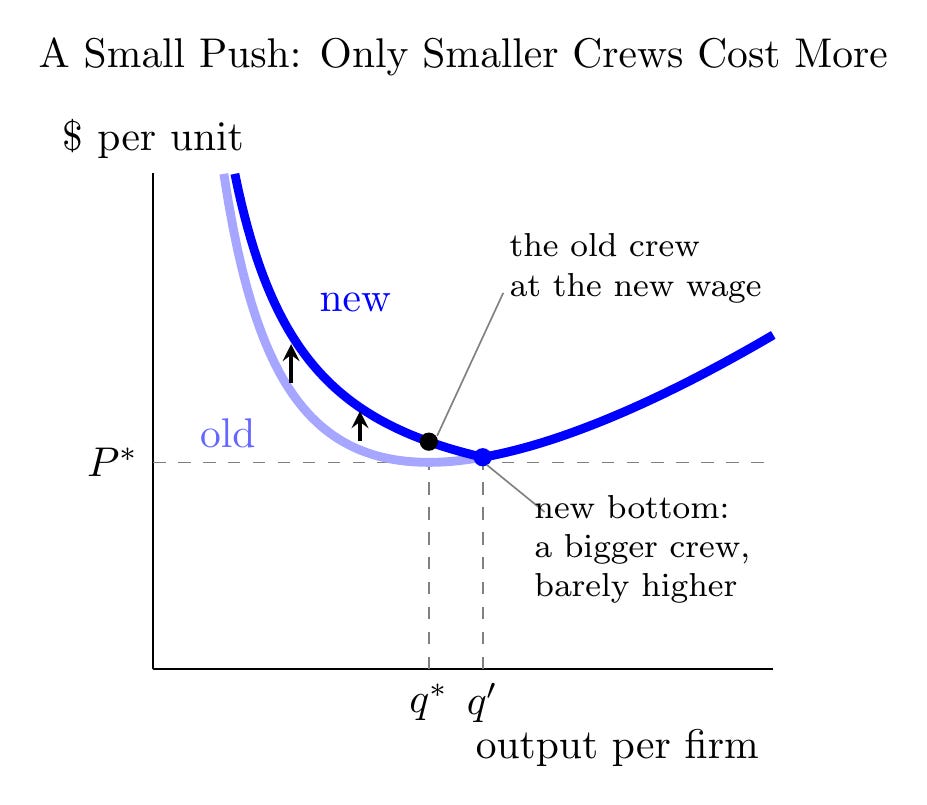
Now, raise the wage slightly via the minimum wage. Hold fixed the set of employees a firm has. Its cost per unit would rise in proportion to the rise. But they’re not stuck with the old crew exactly and their marginal costs have changed. Everyone already earns the new wage, so the next few trades, the ones whose market wage is below the new wage, can join without forcing a raise on anyone. That’s the Armen-and-Bengt logic from “Be Careful about Costs,” where hiring Bengt meant raising Armen’s pay. The higher wage raises the firm’s average cost of labor but lowers its marginal cost of a hire. So firms add roles.
The higher wage lifts the cost of every crew smaller than the one whose last trade earns the new wage. But that bigger crew costs exactly what it always did, since the new wage is just its last trade’s market wage. And it sits right next to the old bottom, where the U is flat.
So the bottom of the U barely rises, and that’s what sets the price. The old crew got more expensive, but nobody builds with it anymore, and the cheapest crew costs almost what it did before. Price barely moves, and buyers want about the same output.
.
Wait. Didn’t the rule raise costs and shrink the industry in the last section? It did. Imposing the rule raises cost per unit at every team size, so Buchanan and Tollison’s long-run story works there. It doesn’t work for a small push from the bottom of the U.
Firms do leave, though the industry barely shrinks. Its output is set by demand at the bottom of the U, and the bottom barely moved.
They leave because the firms that stay are bigger, so nearly the same output needs fewer of them. And bigger teams use more workers per unit of output, because each added role adds less than the average role already there. So teams grow. The number of firms falls. And employment rises.
Now think about what the exit costs, which takes us back to opportunity cost. Society’s cost of the industry’s output has two parts: every firm’s fixed cost, and what every worker could earn elsewhere. Society’s costs don’t include any of those rents since those are simply transfers. Since price barely moves, we can compare the cost of producing the same output.
Each firm that leaves stops paying its fixed cost. That’s a real saving to society. The firms that stay add roles, filled by workers who could earn more elsewhere than anyone already on a crew. The firms that close send their crews back to their outside jobs. Count both, and the industry uses more labor, measured at what those workers could earn elsewhere. That’s a real cost to society.
Near the wage firms pick, the fixed-cost saving is the bigger one, as long as rent per unit of output rises with crew size.
At the team size firms picked, growing a little would have cut fixed cost per unit by exactly as much as it raised payroll per unit. That comes from being at the bottom of the U curve above. To the firm, that whole payroll increase is a cost. But part of it is rent, which society doesn’t count.
In that case, the higher wage raises the firm’s cost but lowers society’s. Consumers pay about the same, firms still earn zero profits, and the gain shows up as higher rents for workers. So here, more rent comes with less waste.
The big idea is that we still have the normal gap between private and social costs. When that happens, we usually get an inefficiency. That’s the key disconnect. The long run doesn’t change that. The wage firms pick is the least costly wage for the firm, not the least wasteful one for society.