

If you’ve been following the news, you might have seen the recent actions taken by the United States to support the Japanese yen. A number of commentators have weighed in on this and remarked about the unprecedented nature of this action. Why is the U.S. supporting the yen? Why is the U.S. intervening at all in foreign exchange markets? Why is Treasury Secretary Bessent so adamant about doing “whatever it takes” to support the yen? Can the U.S. actually do whatever it takes? How can we think about this in terms of monetary and fiscal policy? What sorts of issues of political economy need to be assessed here?
I thought that I would take a moment today to try to explain what is happening and why it happened. I’m going to start with an abstract discussion of exchange rate intervention and then get into the specific issues at hand.
Thinking About Exchange Rate Intervention
Japan does not have a fixed exchange rate with the dollar. Nonetheless, let’s start by considering the world of fixed exchange rates to understand the role of intervention in foreign exchange markets.
Suppose that I run a country, Freedomland, and I have my own currency, freedom bucks. I decide that I want to peg my currency to the dollar at 100 freedom bucks per dollar. Naturally, my country is going to have to acquire dollars over time in order to maintain dollar-denominated reserves.
The problem I face by pegging my currency to the dollar is that there is an asymmetry in terms of the control of this exchange rate. For example, consider what happens when my currency appreciates. In that case the exchange rate might go to 95 freedom bucks per dollar (it takes fewer freedom bucks to buy a dollar and thus my currency is more valuable, all else equal). When this happens, I can print more freedom bucks and use them to buy dollars. The increase in the relative supply of freedom bucks will tend to push the exchange rate back to 100 freedom bucks per dollar. Furthermore, since I am able to print as many freedom bucks as I like, I can always print enough freedom bucks to depreciate the exchange rate back to the fixed exchange rate.
The asymmetry arises when things move in the other direction. Suppose that the currency depreciates to 105 freedom bucks per dollar. I need to intervene to strengthen the currency. I do this by using the dollar reserves that I have accumulated to buy freedom bucks and remove them from circulation. The asymmetry arises because I do not have the ability to print dollars. As a result, I only have a finite supply of dollars. Whether I’m able to get the exchange rate back to 100 freedom bucks per dollar depends on my credibility in using dollars to buy back my own currency.
Suppose that people do not believe that I’m committed to doing this. They can make a bet that freedom bucks will continue to depreciate. They can do this by borrowing freedom bucks, selling them for dollars, and investing those dollars in low-risk dollar accounts to earn some interest.
To see how this works, consider the following example. Suppose that you don’t think I have enough reserves to defend the peg, or that I am not committed to draining my reserves to defend it. The current exchange rate is 105 freedom bucks per dollar. You borrow 1050 freedom bucks and sell them for 10 dollars. Assuming that the interest rates in both countries are the same (more on this below), this is just a bet that the currency will continue to depreciate. To make things really simple, suppose that interest rates are 0 percent in each country. If the exchange rate moves to 110 freedom bucks per dollar, 10 dollars will buy 1100 freedom bucks. You can pay back your loan of 1050 freedom bucks and have 50 freedom bucks left over.
If a lot of people believe that my currency will continue to depreciate, they will all make this bet. All else equal, this creates a lot of selling of freedom bucks, which tends to cause depreciation. In order to correct this, I have to sell a bunch of dollars to buy back the freedom bucks and remove them from circulation. The weaker the selling pressure from speculators, the easier this is to do. However, suppose that I start draining my dollar reserves. As that happens, speculators will recognize that I cannot continue this forever. Once I run out of dollars, I will be helpless to support the value of freedom bucks. Thus, as my dollar reserves drain and the exchange rate fails to correct, this will tend to pull more and more speculators into the market. Eventually, I will be forced to give up. Once I do, there is no buying to offset all of the selling and freedom bucks will depreciate very rapidly with no hope of returning to the fixed exchange rate.
The asymmetry means that I might not be able to fix my exchange rate alone. The postwar experience of fixed exchange rates is littered with examples like this. The standard story goes like this. A country with high inflation wants to restore credibility to policy and bring inflation down. They impose a fixed exchange rate. When they do so credibly, in the short-run the exchange rate stabilizes, inflation comes down, and things improve. However, they face the problem of asymmetry at some point in the future. Knowing this, they need to transition away from the fixed exchange rate. Nonetheless, it is never clear when they should do this. If they do it too early, they might immediately lose credibility. If they wait too long, they might be subject to a speculative attack.
The way that one can avoid a speculative attack is if Freedomland could partner with the United States on this fixed exchange rate. For example, if freedom bucks depreciate to 105 freedom bucks per dollar, I can start using dollars to buy back freedom bucks, the U.S. could use dollars to buy freedom bucks, or some combination of both. Since the U.S. can print unlimited quantities of dollars, they will always be able to print dollars to buy freedom bucks. Of course, this raises an important question. Why would the U.S. care about Freedomland’s exchange rate?
Japan
As I said at the beginning of the previous section, Japan does not have a fixed exchange rate. However, to give the reader an idea of the importance of international trade, total trade (imports and exports) as a percentage of GDP in Japan is around 45%. As a result, although Japan doesn’t have a fixed exchange, it might still have a desire to intervene in foreign exchange markets to prevent significant moves in its exchange rate with the dollar (because of the dollar-based international trade system). The same principles of intervention apply.
Currently, Japan finds itself in a difficult position. Following Japan’s rapid growth in the postwar period, the Japanese economy has experienced slower growth since the early 1990s. Over the last 40 years, the Japanese economy has grown only around 1.3 percent per year on average. The average annual inflation rate from 1986 to 2021 was around 0.5 percent per year, experiencing deflation in nearly a third of those years. At the same time, Japan’s debt-to-GDP ratio has risen to over 200 percent. For years, people have been debating what happened to Japan. I’m not going to discuss those debates here. Instead, I present this as background information.
Back around 2012, Shinzo Abe introduced what was deemed “Abenomics.” This policy was designed to stimulate the Japanese economy and boost growth. The idea was to create an inflation target of 2 percent through aggressive bond buying by the Bank of Japan, to use fiscal policy to boost aggregate demand, and then also do various supply-side reforms related to tax policy and labor market regulation. Aggressive expanstionary monetary policy included implementing negative interest rates. In fact, the Bank of Japan’s policy rate was negative from 2016 through 2024.
In the aftermath of the pandemic, when a number of countries including the United States experienced high rates of inflation, central banks around the world started aggressively raising interest rates. As I just alluded to, this did not occur in Japan. The Bank of Japan continued to have a negative policy rate until 2024 when the policy rate was raised to 0.25 percent. This was in response to inflation finally rising above the Bank of Japan’s 2 percent target.
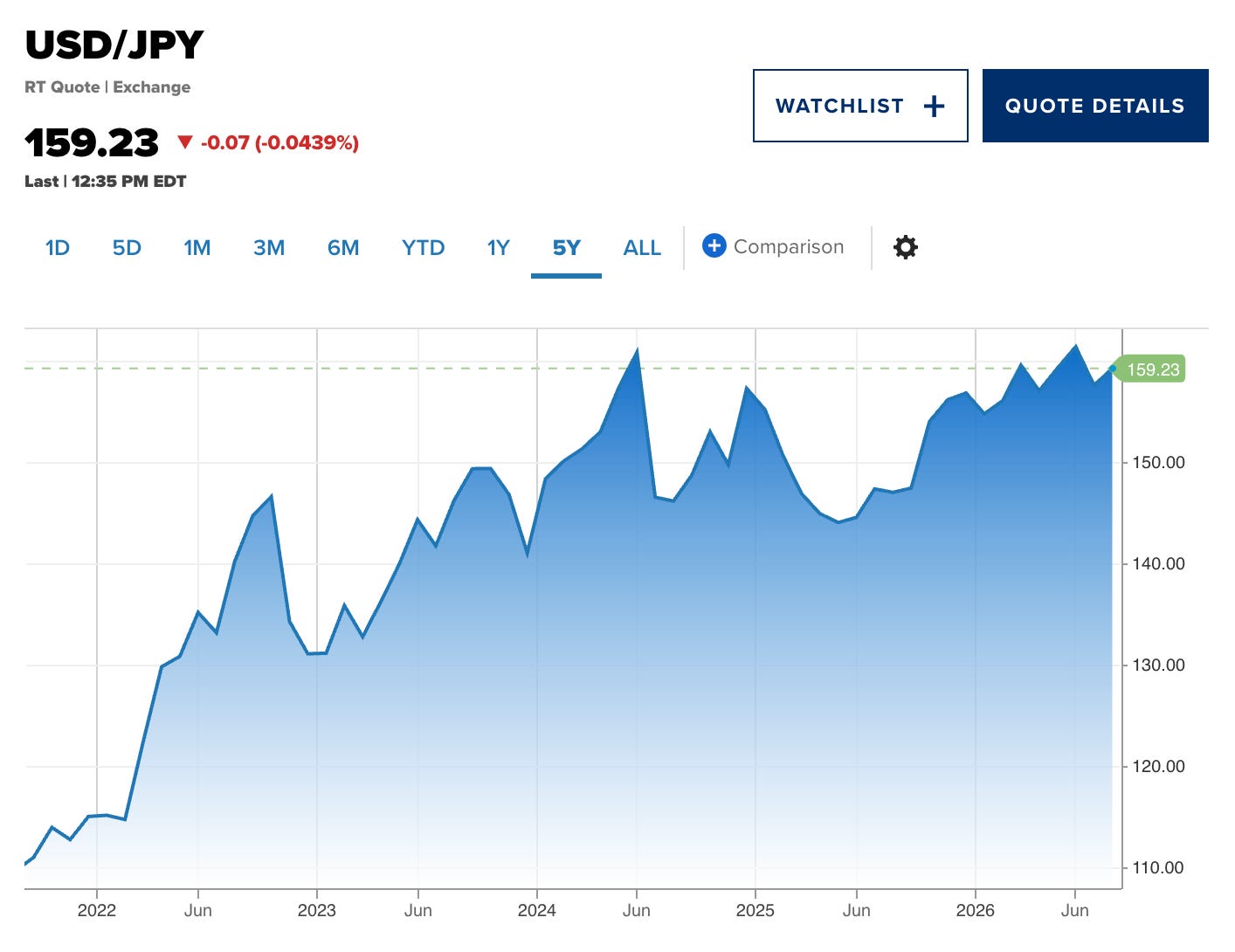
The important thing to realize here is that this dramatic interest rate discrepancy between Japan and other developed countries has fueled what is called the yen carry trade. This is equivalent to the abstract example that I gave above. What people are doing is they are borrowing the yen, selling it for some other currency (like the dollar) and then investing those dollars in low-risk, interest-bearing assets. This trade enables people to profit from the interest rate differential. But remember from our abstract example, as this type of trade expands in volume, it tends to depreciate the currency. This is exactly what has been observed in the post-pandemic period with the yen, which has experienced a pretty dramatic depreciation. (See the chart below, courtesy of CNBC.)
This has created a problem for Japan for several reasons. The first is that inflation is now above the Bank of Japan’s 2 percent target. The BoJ has been raising its policy rate to try to push inflation back down toward its target.
A higher policy rate creates another problem. Since Japan’s debt-to-GDP ratio is already over 200 percent, raising interest rates starts to increase debt servicing costs. As debt servicing costs rise, this might cause bondholders to become convinced that they won’t be repaid (at least in real terms). Expectations that they will have to continue to raise rates, which increases debt servicing costs, which increases the likelihood of default will tend to lead to increased speculation of further depreciation in the yen. Yet, abandoning the interest rate hikes might signal to the market that the BoJ has given up, which creates the expectation that inflation will remain higher for longer and thus lead speculators to expect a further depreciation of the currency.
