

One of the strengths of price theory is that it teaches you to think about problems in terms of constrained maximization, no matter the context. Yes, price theory often involves markets, but it can also be used to think about institutions, or the “rule of the game” in society. Price theory is fundamentally about costs and choices. Non-market activity isn’t immune from that. Neither is the design of institutions.
With that in mind, I would like to address a topic that has received a lot of attention recently. That topic is central bank independence. We try not to write much about politics here, except to give context or explain what policymakers are doing or whether a policy will accomplish its stated goals. However, it is hard to avoid mentioning the politics of this topic. The discourse about central bank independence is largely a response to what many perceive as political pressure being put on the Federal Reserve by the Trump administration to lower interest rates.
In my view, the political aspect of the issue has been to the detriment of the discourse. Much of the recent discourse consists of people saying “we all know that central bank independence is good.” Some of the better discourse will at least cite an old paper by Alberto Alesina and Larry Summers showing a negative relationship between inflation and their index of central bank independence.
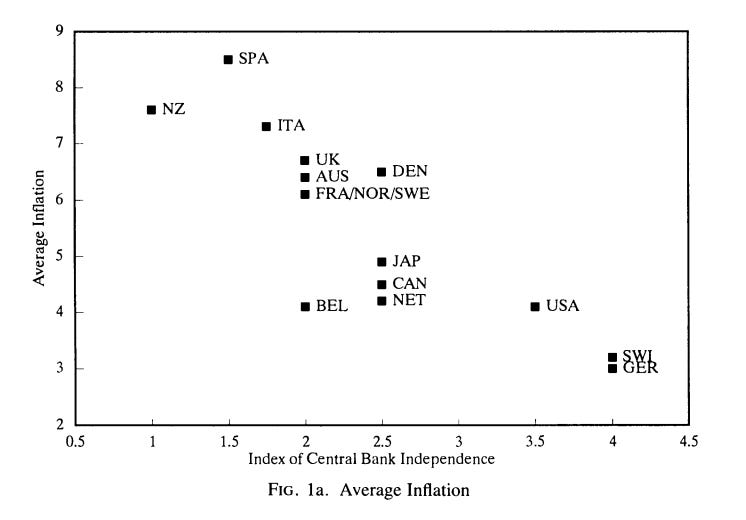
However, the literature on central bank independence is more nuanced than this popular discussion would make you think. We need to think carefully about how we are defining independence. We also need to keep in mind that decisions have tradeoffs. Sure, independence has benefits, but what are the costs? How do we assess the benefits and the costs, and what are the implications for independence?
Tradeoffs
A simple lesson from price theory is that we rarely end up in corner solutions. The opportunity cost of consuming more apples is that I have to consume fewer bananas, but generally I’m not going to consume only apples or only bananas.
When it comes to central bank independence, it is easy to see the potential benefits. If politicians can tell central bankers what to do, then they might direct the central bank toward actions that create short-term benefits for themselves, but impose costs on the general public. For example, increasing the money supply prior to the election might cause a short-term boost to economic activity and improve the politician’s election prospects. However, in the longer-term, this doesn’t make the public better off because the increase in the money supply will simply lead to a higher price level.
Similarly, if politicians know that they can force the central bank to monetize the debt, this effectively relaxes the government’s budget constraint. Politicians will spend more and tax less, resulting in higher inflation for the general public.
The benefit of central bank independence is that it removes politicians from the decision-making process. In doing so, it helps to reduce or eliminate government spending financed by money creation and the type of political business cycle I just described.
It is important to remember, however, that central bank independence also has costs. Consider a central bank that is completely independent of the political process. If that is the case, how could anyone hold the central bank accountable for bad policy decisions or mistakes? No one wants to experience the consequences of bad monetary policy. Even policymakers with the best of intentions might produce bad outcomes.
Thus, although the benefits of central bank independence are pretty obvious, there are costs as well. There is a tradeoff between independence and accountability. The design of a central bank must take this tradeoff into account. In fact, I would argue that the design of many modern central banks does demonstrate a recognition of this tradeoff. However, to see it, you have to understand the nuances of what is meant by central bank independence. The common, broad definition is too imprecise.
What is meant by independence?
People seem to get the basic idea behind central bank independence. It means that the central bank is independent of the political process. But is it? In what way? Certainly, if we think about the Board of Governors of the Federal Reserve, its members are appointed by the president and approved by the Senate. To what extent is that independent of the political process?
Shortly after Alesina and Summers published their paper, Guy Debelle and Stanley Fischer wrote their own paper that addressed the tension between independence and accountability. They separated out three types of independence. There is goal independence (the ability of the central bank to set its own objective), political independence (the role of government in appointing policymakers at the central bank), and instrument independence (the ability of the central bank to conduct policy as it sees fit). They find that the only type of independence that matters for inflation is instrument independence. In fact, they find weak evidence that goal dependence actually lowers inflation. This suggests that what matters for low inflation is having the government set the goal while giving the central bank controls over the day-to-day operations.
More recently, Ed Balls, James Howat, and Anna Stansbury wrote a paper that starts with a puzzling result. If you look at the data during the 1980s on central bank independence and inflation, you see the clear negative relationship that Alesina and Summers highlighted. However, if you look at the data from the early 2000s, you see that many central banks in developed countries converged on low inflation rates despite there being substantial variation in the index measuring central bank independence. This is puzzling if you think central bank independence is important.
They dig a little deeper and differentiate between what they call political independence (the inability of politicians to influence goals and personnel) and operational independence. What they find is that operational independence has a negative and statistically significant relationship with inflation. They find no evidence that political independence matters.
Examination of central banks throughout the developed world suggests that this tradeoff between independence and accountability is recognized. Central banks tend to have limited, if any, control over their goals. These goals typically come from the government. Most central banks in the developed world have instrument independence, and all of them have some degree of accountability to the government in the form of reports and testimony to legislative bodies.
Concluding Thoughts
Some might read this and think that I am being a bit persnickety in my discussion of central bank independence. Perhaps what people have in mind is operational or instrument independence when they refer to central bank independence.
Nonetheless, I do not think this is trivial. I think that we need to be precise about how we discuss central bank independence. Holding up independence as a particular ideal without properly defining what we mean necessarily pushes accountability to the background. Accountability is important. Throughout their short history, central banks have been known to make mistakes because they have become wedded to a particular ideology or a particular macroeconomic theory. These have typically been costly mistakes. However, even when central banks didn’t suffer from these problems, they have still made mistakes. Good intentions do not rule out bad outcomes. For these reasons, it is important not to dismiss issues related to central bank accountability.
Those who shout about the virtues of central bank independence from the rooftops would be wise to specify what they mean by independence and to communicate in ways that reflect the modern evidence. Absolute independence is neither desirable in theory nor supported by the evidence. Particular types of independence are important. Accountability matters too. We economists spend most of our time discussing tradeoffs. This issue should be no different.
If we expand to dimensions other than inflation, I suspect political independence matters much more (I have climate mandates and broad financial-stability mandates in mind). You could perhaps even argue that these increasingly political mandates are partly endogenous to instrument independence: the operational choice of a floor system enables enormous central-bank balance sheets, which almost inevitably invite political meddling.
The Fallacy of True "Independence"
I would point out that the Federal Reserve was created by an act of Congress (the Federal Reserve Act of 1913) and relies entirely on government coercion to maintain its monopoly on legal tender.
The Fed can never be truly independent because its primary utility is printing money to fund government deficits, enabling welfare-warfare states to spend without raising explicit taxes.
Legalized Counterfeiting and Theft
I view fiat money creation as legalized counterfeiting that dilutes the purchasing power of individuals.
I would point out that the Fed's "independent" monetary policy enriches politically connected banks and elites (who receive the newly printed money first) while destroying the savings of the working and middle classes (The 2008 financial crisis saw favored investment banks, banks and insurance companies benefiting from their failures).
Destruction of the Free Market Price Mechanism
Interest rates are the most critical price in a market economy—the price of time and capital.
An “independent" board of central planners setting interest rates artificially low causes malinvestment, distorts economic calculation, and inevitably triggers artificial economic booms followed by catastrophic busts.
Zero Democratic or Market Accountability
Insulation from politics means the Fed is insulated from the public, yet it remains protected from free-market competition.
The only acceptable policy is to "End the Fed" entirely. Interest rates and banking standards should be regulated purely by voluntary contracts and competition.