

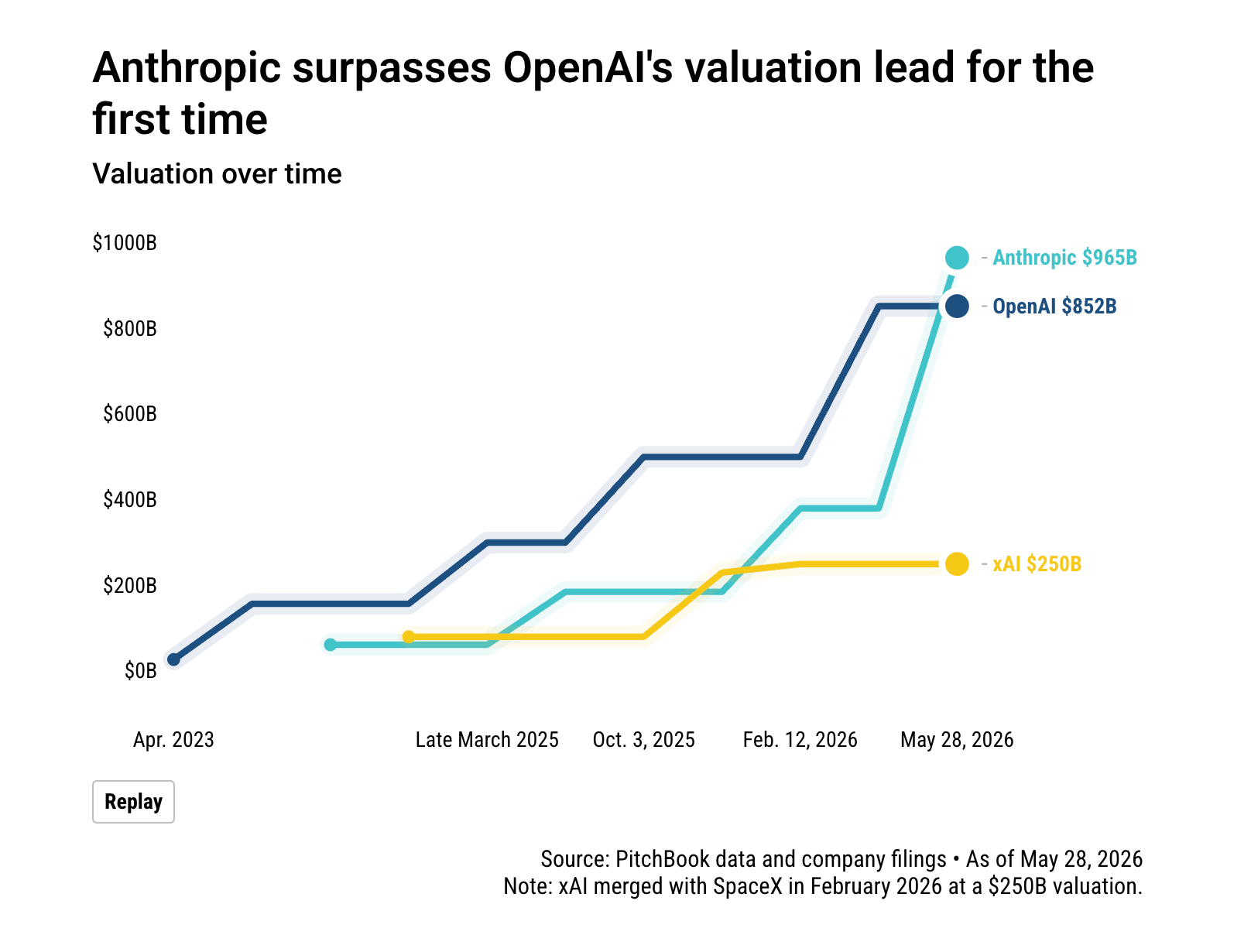
In May, Anthropic raised $65 billion at a $965 billion valuation, passing OpenAI to become the world’s most valuable AI company. OpenAI itself sits at $852 billion. Two companies whose principal product is access to a model—or access to intelligence—are each valued at nearly a trillion dollars because the market believes that building the smartest machine is how you come to own the future.
We are beyond the point where we are asking if AI will be useful. It obviously will be. But the economic question is who will capture the returns, the benefits, the rewards?
The valuations suggest the big labs will, and the AI boomers and doomers (not the AI-will-kill-us-all doomers, but the AI-will-destroy-the-economy people) are in agreement on this. The boomers see a fortune waiting to be won by the companies that build the most powerful models. The doomers see the same fortune being taken away from workers, pushing labor’s share of income down. Both sides imagine a large pool of economic value moving toward AI. They disagree mostly about whether that is exciting or frightening.
In this newsletter, I want to think through whether that is true, and who else we can expect to capture the gains.
There is a distinction between creating value and capturing value. A technology, more generally, any good can generate enormous value while earning almost nothing for the property right holders of that good.
Water is essential to life, yet it is nearly free. Yes, the value generated, or the demand for what, does matter for prices,but only on the margin. Supply matters just as much. Supply and demand, after all. Water is plentiful, so water is cheap, no matter how much life depends on it. The holders of the property rights for water are not becoming billionaires, and those who are make money not from the actual essential part, but from bottling and marketing it in a specific way.
Returns go to goods with the right combinations of value generated and scarcity. We’ve known that basic idea since Ricardo, but the marginal revolution really tied it into a self-contained theory of value and price. Price does not measure the total usefulness of a thing. It measures the value of one additional unit, given how hard that unit is to obtain.
When we start thinking about prices and AI, we already see a water-like aspect going on. For example, the thing these companies are racing to build is collapsing in price. That’s not uncommon. Chips get cheaper. Computers get cheaper. Televisions get cheaper.
What is not ordinary is the speed. When GPT-3 became available in 2021, it was the only model that could score 42 on the MMLU benchmark, and running it cost about $60 per million tokens. Three years later, the cheapest model capable of clearing the same bar cost six cents. I’m not great with numbers, but that seems like a big drop. Epoch AI tracks inference prices and has prices falling to 1/9th the price each year up to 1/900th per year. I’m sure if I looked in the past week, these numbers would have fallen more for some models. Just today, Meta released a model (Spark 1.1) that further competes hard on price.
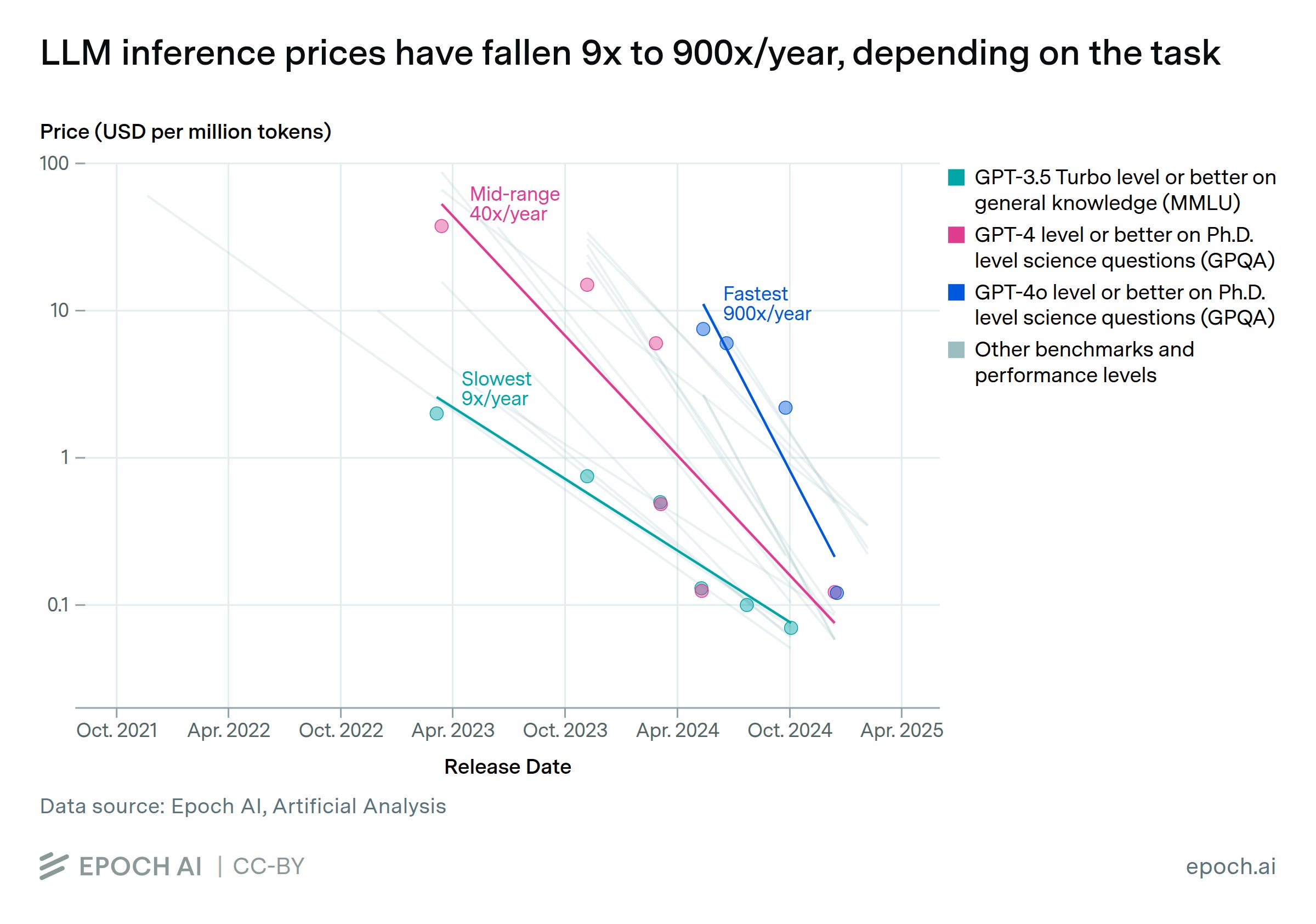
So we have two competing forces. A fixed level of intelligence is becoming abundant, and abundant things are cheap at the margin no matter how useful they may be in total. So you have a horse race, whether the moving out of the intelligence frontier will outstrip the plummeting price for a fixed amount of intelligence.
Nobody is paying nearly a trillion dollars because today’s frontier intelligence will remain scarce. Within a year or two, much of it will be cheap. Investors are betting that the leading labs can keep producing (and controlling) something that does remain scarce. Maybe that’s just the moving frontier, or other things like proprietary data, locked-up compute, privileged distribution, or the workflows that make their products habitual.
But what exactly remains scarce? Alex Imas asks a related question—that I’ll say more about—but focuses on the demand side more. I will focus more on the supply side and who owns the property rights to that which remains scarce.
AI makes intelligence easier to copy
Let’s think of intelligence as a kind of recipe. It is a way of combining ordinary things into something worth more than the ingredients. It is non-rivalrous. My knowing a recipe doesn’t hinder you from knowing it. A baker turns a few dollars of flour, water, butter, and heat into a croissant that people line up to buy. The ingredients are not especially scarce, so the baker’s intelligence, knowledge, his know-how, whatever, allows him to earn a profit.
But there are two different things hiding inside the word recipe.
One is the card. There’s a list of ingredients and steps, the kind of thing you could write down and hand to a stranger. But there’s also stuff that is missing from the recipe card, that the baker forgot to write down or is implicit, like the judgment about what matters, the sequence in which things should happen, the adjustments when conditions change, the tacit sense of quality that separates a good croissant from a mediocre one. I’ll think of the first one as tasks, just like task-based models, and then the second that lumps it all together to generate value, the intelligence.
Pre-AI, even the card was easy to copy. The know-how is not, and that is what makes it scarce. Anyone can buy flour and butter, and anyone can read a recipe card. They cannot easily reproduce the timing and the touch that make the croissant good. The baker earns a premium because the valuable intelligence cannot be separated from the person who has it.
For most of history, much of that recipe was trapped inside the person who knew it. They could teach others. They could write down the ratios and temperatures, but, still, there remained some unique ability (let’s focus on the knowledge side) around maybe timing and judgment. The true recipe remained scarce because it could not be separated completely from its owner, even if you could write down a word-filled recipe. Some important part of the know-how stayed embodied in people, teams, and firms. Knowledge was sticky.
That’s obviously not completely gone yet, but AI seems to loosen that connection between knowledge and where it is embodied. Because intelligence is nonrivalrous, it can replicate and disseminate much faster. That’s definitely true of the written layer, although it is starting to imitate the tacit layer too. It can pull out subtle parts of the craft that were never written down, maybe never articulated at all.
If you give the baker’s recipe to every shop in town, supply increases, and more people may eat them than ever. But no baker earns a premium merely for possessing the recipe, because every baker now has it. Just like on other dimensions, competition pushes the price of the croissant closer to the cost of its ingredients and production. The return to the knowledge drops.
Some of the old premium goes to customers in the form of lower prices. The remainder settles on whichever inputs are still scarce. Maybe there is still something to being on the corner with the foot traffic. Or maybe the oven (not written down) is the key. We could go down the list: the trusted brand, the financing, or the baker whose hands really are faster. Output rises, but the return to knowing the recipe falls. To stay ahead of this process, the baker has to continually come up with new recipes that aren’t copied and ahead of the market.
James Bessen called it the paradox of technical knowledge. Replicable ideas allow us to produce more with the same resources, but the resulting wealth does not automatically accrue to the people who once held the knowledge. When intelligence becomes abundant, bottlenecks matter more
So we get to a world where we have 100 million Einsteins in a datacenter. A huge amount of know-how has become copyable. But the model still has to run somewhere. It requires chips, electricity, cooling, buildings, land, and time. Unlike knowledge, those inputs are rivalrous. Two workloads cannot consume the same GPU-hour or the same megawatt at once.
So the cheapening of intelligence can raise the returns to the complements needed to use it. As intelligence gets easier to copy, users bid more aggressively for the scarce inputs required to run it at scale.
We see this already with physical complements. For example. OpenAI’s gross margin reportedly fell from 40 percent to about 33 percent in 2025. This is while its inference bill quadrupled. Upstream, Nvidia reported a 71 percent gross margin and $193.7 billion in data-center revenue in its latest fiscal year. ASML offers a physical version of this strategy. It is the only company capable of producing EUV lithography machines. The newest cost roughly $400 million each, and the company earned a 53 percent gross margin in 2025. ASML stays rich because competitors cannot simply copy what it makes.
Chips embody a lot of intelligence, but once produced they are rival physical goods. And those are not doing too shabby in a world flooded with intelligence. And those aren’t doing too shabby in a world flooded with intelligence.
Energy has the same structure. It remains scarce for the foreseeable future. The International Energy Agency estimates that data centers consumed about 415 terawatt-hours of electricity in 2024, roughly 1.5 percent of global electricity use. It projects a “demand” of approximately 945 terawatt-hours by 2030. (I can’t seem to tell what price this is assuming for the quantity demanded, which must depend on price, but let’s not fight that battle.)
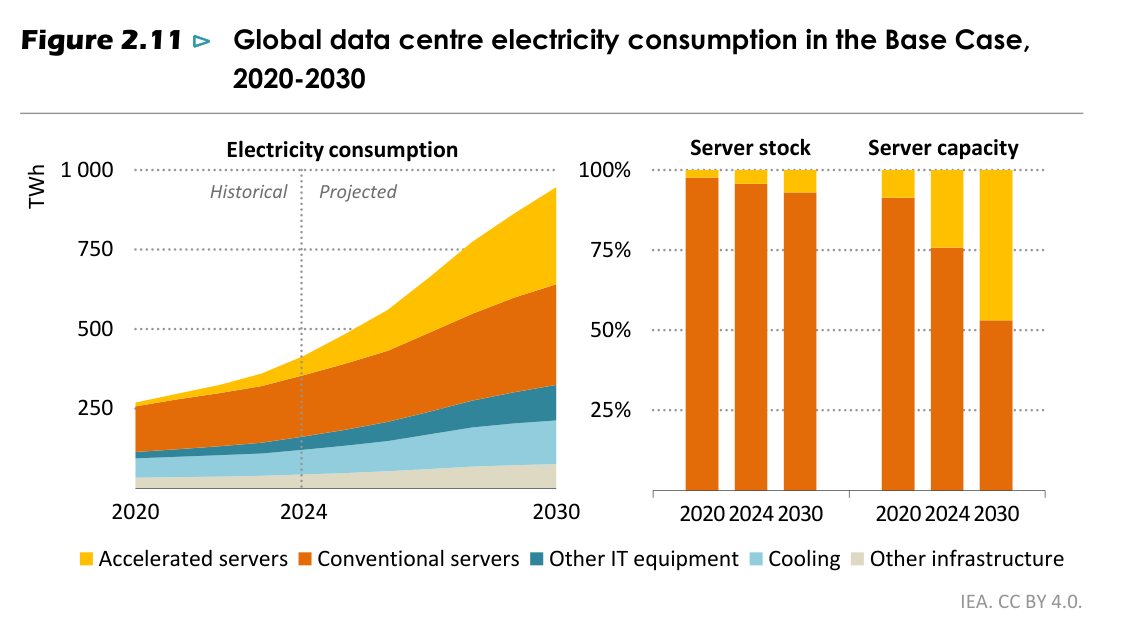
Again, this is Ricardo in a nutshell. The rent goes to the scarce complement. Yes, it’s not conclusive but it suggests the value is spread around, not just to the frontier models. It seems related inputs are doing well.
Bottlenecks have clocks
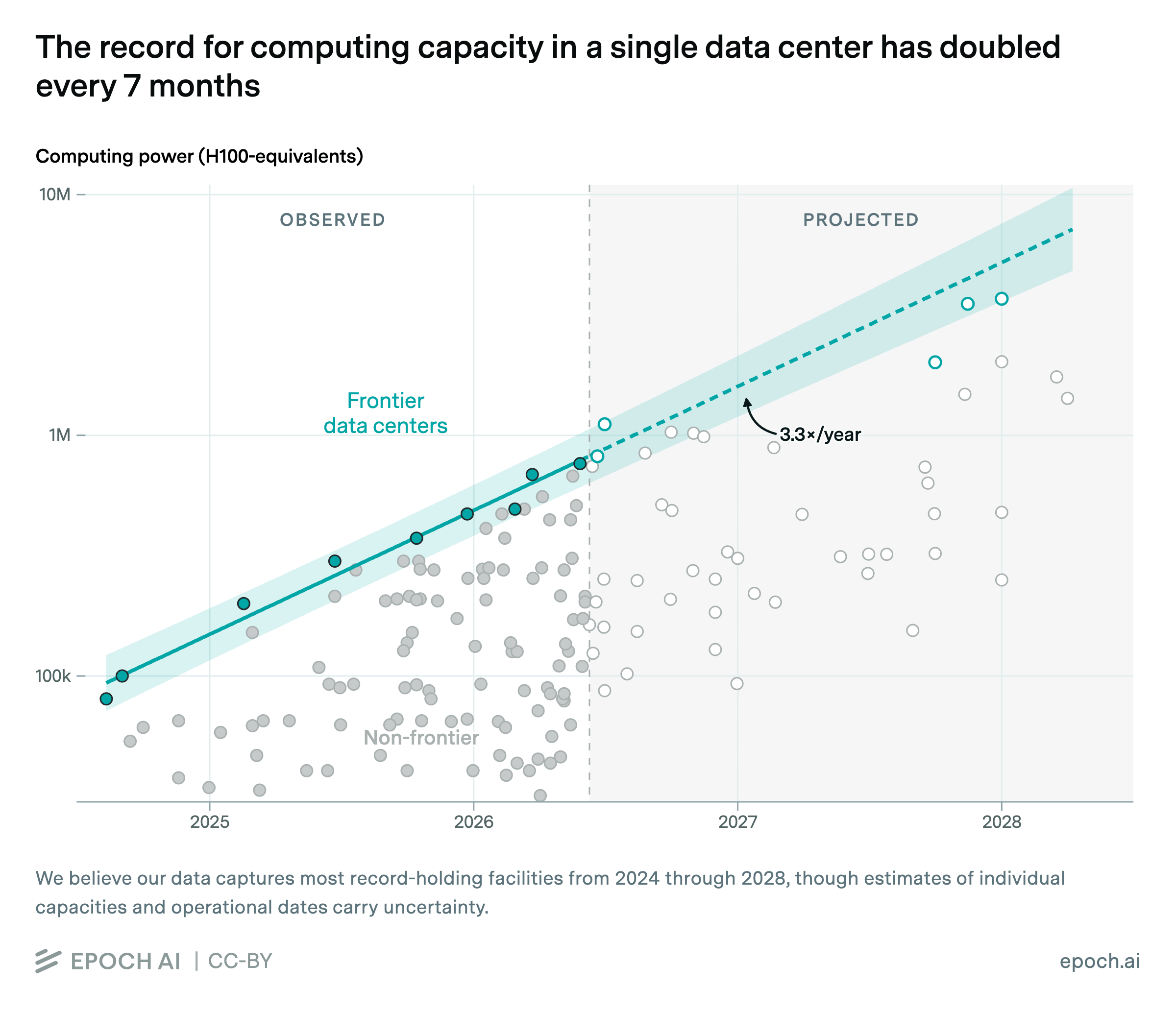
That does not mean chips and electricity will remain scarce forever. High returns attract new fabrication plants, generators, transmission lines, and data centers. It means they are among the clearest bottlenecks today. Markets respond. I think we’ve mentioned that in this newsletter.
So any scarcity has a clock on it. It depends on what is scarce now and how fast it can respond. It depends on elasticities, as always. But those scarcities are responding. We can see that in the data center build out, which requires lots of these inputs into compute which is then an input into intelligence.
No all digital is replicable
Under open and competitive supply, the pure return to a copyable model is pushed toward zero. The service still has a cost because inference consumes scarce compute.
But the recipe itself earns no rent. So we have a distinction between the recipes return and the return to everyone in the supply chain.
Every company wants to avoid that, so they look to ways to exclude. If you prevent the recipe from being copied, you turn a nonrival capability into something rivalrous, which can become a priced asset. All of the physical production has this, ASML or chips, for example. offers a physical version of this strategy. The labs are trying to construct an informational equivalent. Can they have unique intelligence that no one else has? One possible way to get that is to input unique data. So you get that Reddit licensed its archive under contracts worth $203 million. And law may respond. In Thomson Reuters v. Ross, a federal judge rejected an AI startup’s fair-use defense for training on Westlaw material. Copyright and contract can manufacture scarcity around information that would otherwise be cheap to reproduce. So that changes relative scarcity.
This is basically the model in Cockburn, Henderson, and Stern. As algorithms diffuse, the return shifts toward the complementary assets that remain protected. OpenAI understands the distinction. As models improve, it argues, “the limiting factor shifts from intelligence to usability.”
What happens to workers?
So far, we haven’t really talked about workers. But I think we can easily extend the model. What parts of the job become replicable? What is exclusive?
We have to be careful about what the worker is selling. A worker sells an output, whether it be a diagnosis, a legal brief, a repaired machine, a lesson, a design, a relationship, a judgment someone trusts enough to act on. She does not sell “tasks” in isolation.
Let’s think about this in production function terms. To produce that output, she combines inputs. Some are personal, like her knowledge, judgment, taste, reputation, relationships, attention, and time. Some are external and bought over the market, like software, equipment, institutional authority, licenses, assistants, referrals, customers, and the firm or platform that connects her to demand.
Garicano, Li, and Wu work through this in more detail. Given markets price jobs, not tasks. A task only comes loose from the worker/job when it can be cleanly separated from everything bundled around it.
AI enters different places. It becomes an input into the worker’s own production. It makes research cheaper, drafting faster, scheduling easier, or diagnosis more accurate. In that case, AI feeds her work. Inputs become cheaper. If the rest of what she supplies remains scarce, her return can rise. She didn’t do anything more, but her productivity increased, and she captured (at least some of ) the gains.
At the same time, all of her competitors (and new competitors) are also using AI. Maybe some of that is much more “pure AI” and we can think of the AI as the direct competitors. The knowledge that you had is no longer scarce.
So we have a horse race between AI as an input and AI as a competitor. It’s not obvious which of those forces wins.
A decade after Geoffrey Hinton said in 2016 that we should stop training radiologists, the number of radiologists has risen by about 17 percent. AI became better at reading scans, but reading scans was only one input into the radiologist’s output. So far, a scan cannot be cleanly separated from the clinical judgment, the responsibility for the call, or the conversation with the surgeon. So AI did not reproduce the entire bundle of work performed by a radiologist.
Evidence from Upwork already points in this direction. Tracking 49,610 freelancers across more than two million contracts, Auyon Siddiq and Niuniu Zhang find that after ChatGPT, buyers in the most AI-exposed categories placed less weight on credentials and past performance and more weight on price. Demand shifted toward cheaper workers. As the work became easier to standardize, workers began to look more interchangeable. Interchangeable suppliers compete on price, not reputation. You could imagine that same thing happening even for relational goods.
Who owns the human premium?
Alex Imas approaches the same question from the demand side in his essay “What will be scarce?”
As standardized goods become cheaper, richer consumers may spend more on provenance, exclusivity, authenticity, and human connection. In one experiment, Imas and Graelin Mandel found that exclusivity raised the value of human-made art by 44 percent, compared with 21 percent for AI-made art. I think this demand-side argument makes sense.
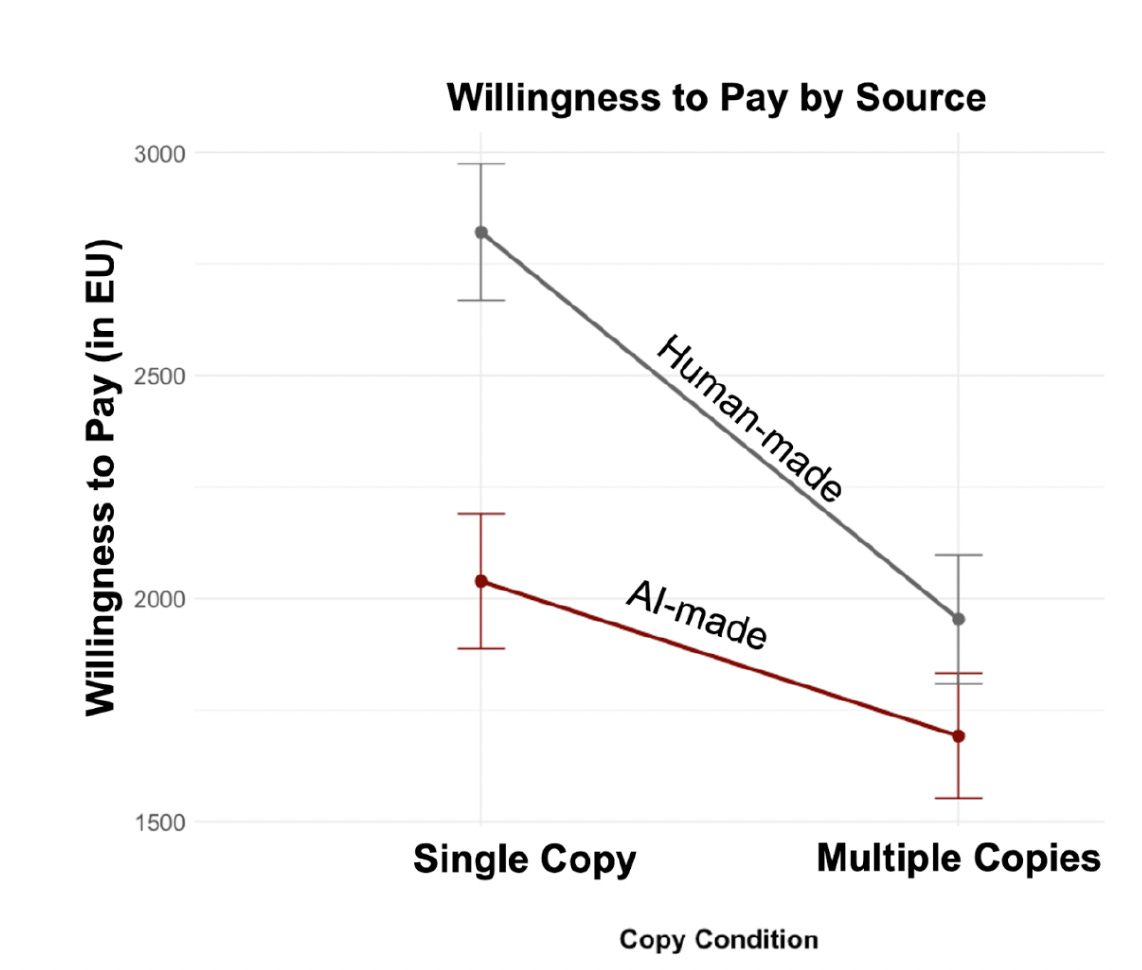
There are two ways to extend it. First, “human” is too broad a category. A human premium can rise in some markets while falling for particular workers in others. The supply side still matters. If AI lets many more people provide an adequate human service, the premium attached to any one provider can fall, even though the service remains human.
Consider a relationship advisor. Her warmth and personal manner may be genuinely unique. But much of the service around that relationship, such as advice, scripts, interpretation, suggested replies, and emotional framing, can be separated from her and reproduced by AI. If AI cheapens her research and preparation, it feeds her work. She can spend more time on the relationship itself. If AI lets a thousand adequate advisors offer similar scripts, similar advice, and similar reassurance to the same clients, it floods her market. Her humanity remains real. The market is just as “human” as before, but the specific service she sells today will become less scarce.
This cannot be the aggregate story, since the supply of humans is basically fixed. The distributional story can still be true. If AI lets many more people provide an adequate human service in a particular market, the premium attached to any one provider can fall even though the service remains human.
This is the same ownership question we have been talking about all along. For workers, ownership often shows up as portability. Can the scarce human input walk away? Can it reach customers without the firm, platform, brand, license, or copyright wrapped around it? If yes, the worker has a claim on the premium. If no, the premium can show up somewhere else.
This isn’t a new problem. Things people think are separable aren’t always.
In the 1920s, a young Walt Disney built a studio around Oswald the Lucky Rabbit, only to discover that the character’s copyright belonged to his distributor. The distributor made the obvious move: keep the character, hire away Disney’s animators, and remove the man who appeared to supply only ideas. The distributor seemed to own every copyable part of the production process: the character and the hands that drew it.
But he did not own Disney’s sense of what was funny. That scarce input could walk out the door. It did, and as far as I can tell, had some success.
The rule
So what’s gonna happen? No idea. But I think we have a framework to think through it.
AI will create enormous value by making intelligence, and the diffusion happens by making it easier to copy. The returns go to whatever remains scarce once the intelligence is cheap. None of this is new. Right now, we see that the scarce thing is physical, like chips, megawatts, and land. Sometimes it is generated or manufactured, like data, distribution, a copyright, a brand. And sometimes it is a person whose judgment or relationships cannot be separated from the service she sells.
When the scarce thing is a person, there is a further twist worth thinking about. Does the intelligence AI is copying feeds her work or floods her market? Copied intelligence that becomes her input raises her return. Copied intelligence that creates her competitors lowers it, even though her own intelligence was never touched.
It is not enough to say intelligence goes brrr, so money goes brrr. Scarcity depends on ownership. Scarcity depends on property rights. What is AI making abundant, what remains scarce, and who owns it? That is where the returns to AI go.