

In the aftermath of the pandemic, there were certain political circles that seemed to blame the high rates of inflation on corporations, and in particular grocery stores. Brian and I wrote a lot about these arguments at the time. I must admit that I assumed that this was a temporary phenomenon. Inflation was high. People were mad. People wanted to blame someone for higher prices. In the absence of broad economic understanding or analysis, it didn’t seem all that surprising that arguments like this would pop up. High rates of inflation tend to create costs that are avoided at lower rates of inflation. This was a major theme of Axel Leijonhufvud’s work on inflation. As inflation slowed, I figured that this trend would decline along with it.
I was wrong. People really seem to be mad at grocery stores and policymakers in certain parts of the country seem intent on figuring out ways to punish them.
What is Going on in Washington?
Politicians in the state of Washington seem particularly upset with grocery stores. A recent story in the Seattle Times summarizes what is going on there. In short, there is an exodus of retail stores from Seattle and the surrounding area. Fred Meyer, a chain operated by Kroger, announced it is closing five stores. This comes in the aftermath of smaller stores like Rite Aid announcing closings of stores in the area as well.
The stores say that they are leaving because of regulatory costs and rampant shoplifting that are raising their costs and making stores unprofitable. Critics claim that these stores took advantage of the pandemic to raise prices and that removing stores from particular neighborhoods will leave people without access to food, creating a so-called “food desert.”
Politicians have responded by promising action. Some have advocated publicly-owned grocery stores. The current Mayor Katie Wilson has said that the city will not allow grocery stores to leave. It is not entirely clear what that means. However, there is legislation introduced by the Washington legislature that would allow the city to use eminent domain to seize the property of grocery stores for use as publicly-owned grocery stores.
I think it is important to note that it is a long-running political trick used by Marxists to impose unbearable costs on firms to create the pretext for expropriation. Nonetheless, this is a newsletter about price theory and not politics. Thus, I will not assume bad faith. Instead, I will take the politicians at their word and use price theory to explain why their proposed solutions are unlikely to produce their desired outcome.
The Underlying Price Theory
Let’s start with basic price theory.
We experienced high inflation. Some people blamed supply-side factors. Some people blamed demand-side factors. But this isn’t a hopeless debate. There are various things that we can do to evaluate which is the more likely outcome. In fact, this is a question for which some basic price theory is especially useful.
For example, if this is a supply-side problem, then rising costs are to blame. If this is a demand-side problem, then fiscal and monetary stimulus are to blame because such policies increase the demand for goods and services, generally. What does price theory have to say about this?
Those who blame grocery stores tend to take a supply-side view. Goods are in shorter supply, it is more costly to supply those goods to the market and the grocery store is “taking advantage” of these cost increases by raising prices and earning higher profits.
Unfortunately for those making this argument, price theory says this explanation cannot be true. While it is true that unexpected increases in costs do lead to higher prices, they also lead to smaller margins. Demand curves slope down. Firms cannot passthrough the entire increase in costs and certainly cannot raise prices by more than the increase in costs. The supply-side story is therefore inconsistent with higher profit margins.
The only way to get higher prices and higher margins is if there is a broad increase in demand. These are caused by things like expansionary monetary and/or fiscal policy, both of which occurred during (and in the aftermath of) the pandemic-related shutdowns.
Thus, much of the backlash against grocery stores seems to be driven by a lack of understanding of basic lessons of price theory.
Optimal Stopping
One of my favorite concepts in all of economics is the study of inaction. The economics of doing nothing. What do I mean by this?
Well, a lot of economic decisions involve significant fixed costs that cannot be recovered later. There are a lot of examples, like the decision to build a new factory or store and the decision to move a long distance. Most of the time, the optimal thing to do is nothing. Behavior thus appears lumpy. If you look at the data, the spending of individual firms for things like capital investment tends to be relatively low or even zero in most periods. But then there are periods when investment spending is very high. This is because the firm has the option, but not the obligation to invest in a new factory or a new retail store. Because the investment entails a large fixed cost and the fixed capital investment might not be a perfect substitute for other firms, the firm must take care to make sure it is really worth building, given the uncertainty of the market. In other words, you don’t want to build the establishment if an immediate downturn in the market would render it unprofitable. The firm would want to wait until it has a significant cushion in the value of the investment that the firm could absorb in a downturn without squandering profitability.
But how can we think about that cushion or how big it would need to be?
It turns out that this is just a standard pricing problem. Since the firm has the option, but not the obligation to invest and this option doesn’t typically expire, the value of a potential project can be priced in the same way that an American financial option would be priced. Since it doesn’t expire, there is an additional problem to be solved, which is the decision about when to exercise the option (which itself affects the value).
The reason that this idea is important for the discussion of grocery stores is that it relates to entry and exit decisions of firms. Think about the decision to shut down. Doing so is costly. The firm is giving up the present discounted value of future profits. The firm also incurs direct costs of shutting down. Maintaining the real estate until one can find a buyer is costly. Finding a buyer is costly because the physical establishment was designed for the purpose of the firm. It is a particular type of establishment. Those who would have the greatest use are those that are in the same business. Given that your firm was unsuccessful, it is unlikely there will be competing firms jumping at the chance to operate in your location if you shut down.
But there is some basic logic here. If policymakers create a regulatory environment that is costly or if policymakers adopt a lax attitude on crimes like shoplifting, this significantly reduces the present discounted value of expected future profits. As a result, it makes it more likely that a firm that never would have left (or would have possibly left at some point in the distant future) will exit now.
Even policies like using eminent domain are likely to have perverse incentives. Eminent domain requires compensation to the party whose property has been taken. To the extent to which the fixed cost of exit is related to the maintenance cost of the real estate left behind, a policy of eminent domain might hasten the decision to exit of the marginal firm.
In addition, firms considering entering the area will take into account the costs of exiting before they even enter. This is something that Brian wrote about last week in labor markets. If it is hard to fire workers, then it is more costly to employ workers. If it is more costly to employ workers, firms will employ fewer workers. The same concept applies here. If a firm sees that the state is trying to raise the cost of leaving, then a firm might never enter in the first place. There is already uncertainty about profitability. That uncertainty coupled with the large, fixed cost of investment is what prevents firms from entering in the first place. Punishment costs associated with leaving thus increase the cost of entry because they lower the option value of exit. As a result, fewer firms are likely to enter.
We’ve Seen This Show Before
The public grocery store issue isn’t new. We have seen this show before. Brian previously wrote about Boris Yeltsin’s famous visit to a Houston grocery store. Even as a member of the Soviet elite, Yeltsin was amazed at the organization, scale, and scope of American grocery stores.
A lesser known story is that of the one-time famous fund manager, Jim Rogers, who took a trip around the same period of time in the opposite direction. Having retired young and wealthy, Rogers decided to take a tour of the entire world on his motorcycle. He documented the trip in his book Investment Biker. What he found when he visited Soviet Russia were stores with long lines and empty shelves. There was little product variety or access to basic things Americans take for granted.
In more rural areas, he met shopkeepers who told him that they had never experienced inflation. Prices hadn’t changed in years. Of course, prices had changed elsewhere. Poles were known to come into Russia, buy whatever was available, and return to Poland to sell the goods at market prices. Shelves were empty. And when global prices, like the price of oil, increased elsewhere, the Russians sold the oil at higher prices outside of Russia and rationed whatever was left inside of Russia.
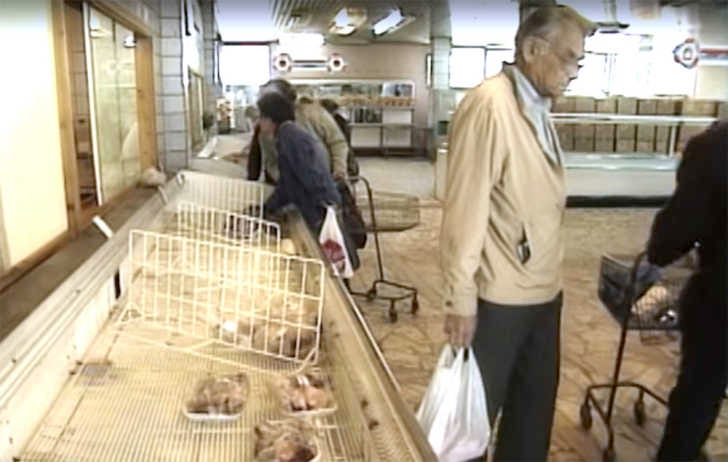
The ability of prices to coordinate economic activity is what explains the abundance of options and the fully-stocked shelves at American grocery stores. Yet, this is precisely what policymakers want to eliminate. They want command and control over prices. They think that bureaucrats will do better at setting prices than the people like grocery store owners and managers, who possess a particular knowledge informed by past experiences and circumstances.
In fact, they give away the game when they say that they will simply use existing prices to control the profit margins. They’re simultaneously admitting that they need markets to operate effectively while noting that, unlike traditional grocery stores, they don’t need to make a profit to survive. That is apparently why one needs taxpayers. But if taxpayers are subsidizing these stores, the prices in the public grocery store might be lower, but the cost to the marginal consumer will be higher.
Costly Policies Are Not the Cure for Other Costly Policies
It is understandable why people are frustrated. Experiencing the highest inflation rate of the last 40 years was not pleasant for anyone. The prospect of losing neighborhood grocery stores, especially for those who lack their own transportation is not desirable. However, it is important to recognize that these unpleasant things are not inherent problems with our economic system, but rather the result of policy choices made by elected officials and central bankers. The solution is not to fight the costs of previous policies with new costly policies. This whack-a-mole policy environment will only compound the costs.